Hurricane and emergency preparedness for Louisiana seniors: a family plan
In 2026, the fastest way to protect an older Louisiana loved one before a storm is to build a go-bag with a week of medicines and a medical-records list, back up any oxygen or medical device, and enroll them in your parish special-needs evacuation registry. Statewide, dial 211 for disaster help; in New Orleans, dial 311 to register.
In 2026, the fastest way to protect an older Louisiana loved one before a storm is to build a go-bag with a week of medicines and a medical-records list, back up any oxygen or medical device, and enroll them in your parish special-needs evacuation registry. Statewide, dial 211 for disaster help; in New Orleans, dial 311 to register.
If your parent lives anywhere from the coast at Houma and Grand Isle up through Jefferson, Orleans, and the Northshore, hurricanes are part of life, and an older adult with medicines, mobility needs, or oxygen has more to plan for than most. The good news is that Louisiana has real systems built for exactly this. Atlantic hurricane season runs June 1 to November 30 (National Hurricane Center), so the time to make a plan is now, calmly, not when a storm is already named. This guide walks your family through the plan, the registry, the questions to ask a care community, and how to come home safely.
How do I build a hurricane plan for an aging parent in Louisiana?
Start early, well before a storm is named. Build a plan around four things: at least a one-week supply of medicines, a backup for any oxygen or powered medical device, a packed go-bag, and a printed medical-records sheet. Then enroll your parent in your parish special-needs evacuation registry and pick where they will go.
A senior's plan is different from a general household plan in a few ways that matter. Medicines cannot lapse, so you want more than a few days on hand and a way to keep refrigerated ones cold. A parent who cannot drive, cannot walk far, or depends on electricity for a device needs help arranged in advance, not improvised. And the decision to leave should be made early, because evacuation traffic and a parent who moves slowly do not mix well. The state's official planning tool, getagameplan.org, walks any family through building a plan, and the steps below add what an older adult specifically needs (GOHSEP, 2026). Decide two things with your parent now: where they will go if you evacuate, usually to family or a friend inland, and who is responsible for getting them there.
What goes in a hurricane go-bag for a senior?
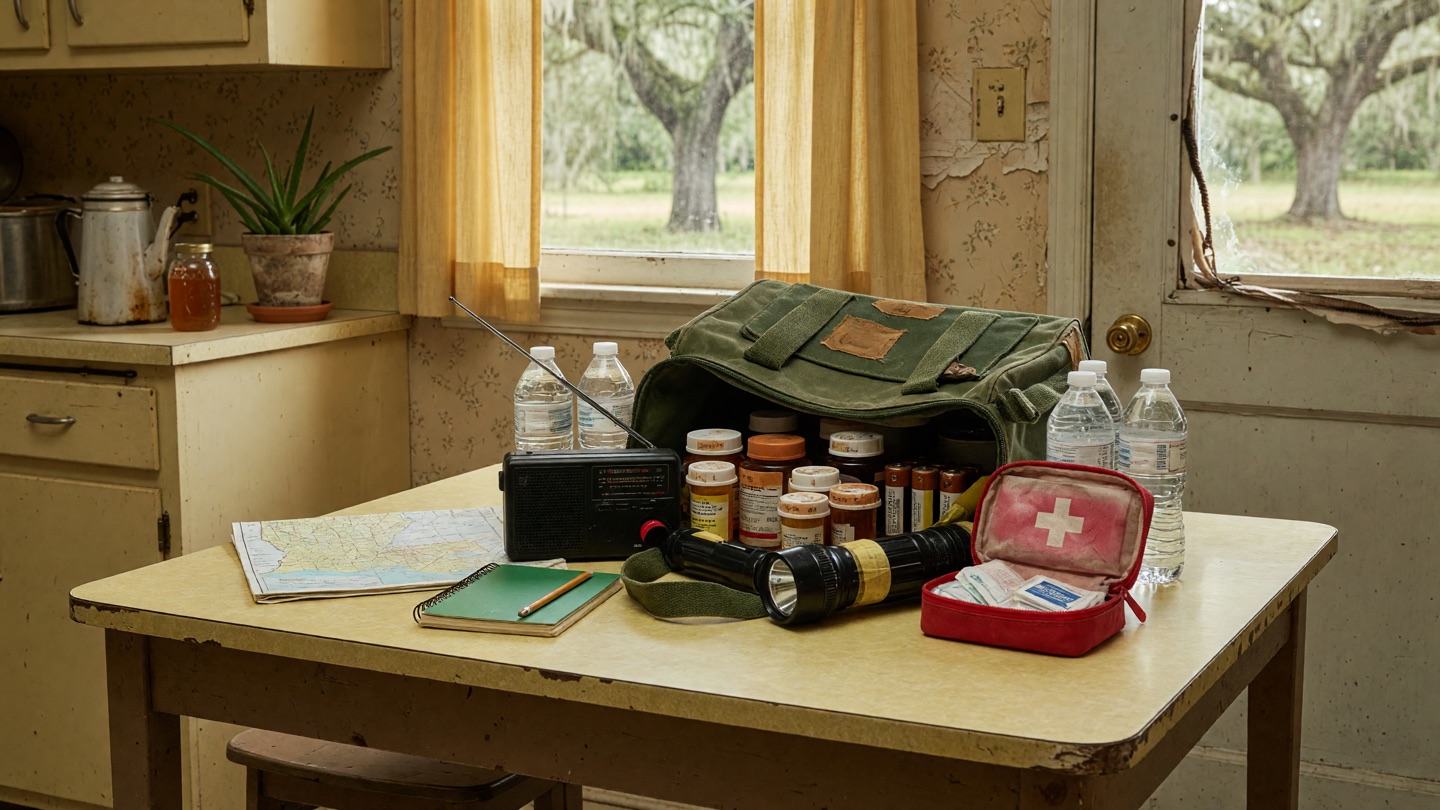
Pack a go-bag your parent can grab in minutes. It should hold a week of medicines in original bottles, a written medication and dosage list, copies of insurance and Medicare cards, a photo ID, a list of doctors and emergency contacts, glasses, hearing-aid batteries, chargers, some cash, and comfort items.
Federal and state guidance for older adults all point to the same core kit, with a few senior-specific additions (Ready.gov; GOHSEP). Here is a practical checklist to pack once and keep by the door:
- At least a one-week, ideally two-week, supply of all medicines in their original labeled bottles.
- A written list of every medicine, its dose, and the pharmacy, plus a printed medical-records and allergies sheet.
- Copies of the insurance card, Medicare or Medicaid card, and a photo ID, in a waterproof bag.
- A list of doctors, the preferred hospital, and family emergency contacts, on paper, not only in a phone.
- Backup supplies for devices: extra oxygen if approved, hearing-aid batteries, glasses, a spare cane or walker, and any catheter or ostomy supplies.
- Phone and a charger, plus a battery pack, and a simple written note with your parent's name and needs if they cannot speak for themselves.
- Water, a few days of easy food that fits any diet, a flashlight, and a small amount of cash for when card readers are down.
- A comfort item or two, a change of clothes, and any assistive item that helps a parent with memory loss stay calm.
Keep the bag somewhere your parent can reach it, and check the medicines every few months so nothing expires.
How do I enroll my parent in Louisiana's special-needs evacuation registry?
In most parishes you enroll through your Parish Office of Homeland Security and Emergency Preparedness, which keeps a voluntary registry of residents who will need help evacuating. In New Orleans, dial 311 or text EVACNOLA to 77295. Statewide, dial 211 for disaster help. Sign up before hurricane season, not during a warning.
Louisiana law asks each parish to keep a voluntary registry of at-risk residents and people with special needs who will require help during an evacuation, so a parish knows in advance who may need a ride, a lift, or medical attention (GOHSEP). Registering does not commit your parent to leaving, and it does not replace your own plan; it simply puts them on the list so help can reach them if they cannot get out on their own. Because the exact method differs by parish, use the routes below and confirm the current process with your local office.
| Where your parent lives | How to register | Confirm with |
|---|---|---|
| Orleans Parish (New Orleans) | Dial 311, or text EVACNOLA to 77295, to join NOLA Ready's special-needs registry and City-Assisted Evacuation; sign up if they use oxygen, a ventilator, dialysis, a pacemaker, or insulin | ready.nola.gov |
| Jefferson Parish | Register through the Parish's Assisted Evacuation process for residents who need public transportation to evacuate | Jefferson Parish OHSEP |
| St. Tammany Parish (Northshore) | Enroll through Smart911, which the parish uses so responders see medical and special needs | St. Tammany OHSEP / Smart911 |
| Any other parish | Call your Parish Office of Homeland Security and Emergency Preparedness and ask for the special-needs or medical-needs evacuation registry | gohsep.la.gov parish directory |
For any parish, dial 211 for round-the-clock, free disaster help with shelter, food, and where to turn, and use the GOHSEP parish directory at gohsep.la.gov to find your local emergency office (Louisiana 211; GOHSEP). The Governor's Office of Elderly Affairs also supports older Louisianans through the local Council on Aging and can point you to disaster help for seniors (GOEA). Please confirm all numbers and enrollment steps when you call, because local processes change from year to year.
What should I ask my parent's assisted living or nursing home about its hurricane plan?
Every Louisiana nursing home files an emergency plan with the state each year, and assisted living communities must plan too. Ask whether they shelter in place or evacuate, where residents go, how they get there, whether a generator runs medical equipment, how staff track medicines, and exactly how they will reach you.
Louisiana learned hard lessons about facility evacuations, and the rules now reflect that. Nursing homes must submit an emergency preparedness plan to the Louisiana Department of Health each year for approval, and those plans have to spell out evacuation host sites, transportation providers, how residents are triaged by need, and generator details (Louisiana Department of Health). If your parent is already in a community, or you are touring one, do not assume; ask directly. Here are the questions that matter most:
- In a mandatory evacuation, do you shelter in place or move residents out, and who makes that call?
- Where exactly do residents go, and how far away is the host site?
- How are residents transported, and how do you move someone who is bedbound or uses a wheelchair?
- Does a generator run heat, cooling, and medical equipment like oxygen concentrators, and for how long?
- How do you keep and track each resident's medicines during an evacuation?
- How and when will you tell me where my parent is, and how do I reach them or you during the storm?
- What happens with staffing, and who cares for residents if roads close?
A good community will answer these plainly and may show you its plan. Vague answers are themselves an answer.
How do I keep medicine and oxygen safe when the power goes out?
Talk to the doctor, pharmacy, and equipment supplier before a storm about a power-outage backup plan. Keep refrigerated medicines like insulin in a cooler with ice packs, and ask the pharmacy how long each one stays safe at room temperature. If your parent depends on an electric medical device, tell the power company.
Power loss is the most common danger after a Louisiana storm, and it hits seniors hardest. If your parent uses oxygen, a wheelchair, a power scooter, refrigerated medicine, or any powered equipment, arrange the backup ahead of time with the provider or supplier, because you cannot solve it during an outage (GOHSEP). Ask the pharmacy now for a larger supply going into the season so a week without a working pharmacy is not a crisis. For refrigerated medicine, a cooler and fresh ice packs buy time, and the pharmacy can tell you the safe room-temperature window for each drug. Many utilities keep a list of customers who rely on electric medical devices so they can prioritize and check on them, so call your power company and ask to be added. Keep phones and battery packs charged whenever a storm is in the forecast.
What is safe when we return home after the storm?
Go back only when officials say the area is safe, and check for hazards like downed wires, broken glass, and standing water before your parent goes inside. Watch older adults closely for heat exhaustion when the power is still out, throw away perishable food left unrefrigerated more than four hours, and restock any spoiled medicines.
Coming home can be as risky as the storm itself for an older adult. Let a younger family member go in first to check for downed power lines, gas smells, broken glass, weak floors, and standing water before your parent enters (AARP). Heat is the quiet danger while power is still out: older adults are more prone to heat exhaustion, so watch for heavy sweating, pale or cool skin, weakness, a fast pulse, nausea, or dizziness, and cool them down by staying on the lowest floor, closing blinds, using battery fans, and keeping fluids up. Throw out any perishable food that sat unrefrigerated for more than four hours, and if the freezer thawed, when in doubt, throw it out (FoodSafety.gov). Replace any medicine that spoiled or was left behind, and watch for confusion, irritability, or exhaustion, which are common signs of stress in seniors after a disaster. Take the recovery slowly, because the days after a storm are when many older adults are most at risk.
How a Louisiana advisor helps: A storm plan is one more thing to carry when your family may already be weighing whether your parent can keep living where they are. A local advisor can help you think it through, from whether a home with backup power still makes sense to which communities have strong evacuation plans, and can point you to the right parish resources. You work with one advisor, your family is never sold to a list of companies, and a move to a community is only ever one option, never the default. Because families pay nothing for this help, a first conversation costs you only the time to talk.
This is general education to help your Louisiana family prepare, not medical, legal, or emergency advice. Registry steps, phone numbers, and local rules change, so always confirm the current details with your parish emergency office and follow the instructions of local officials during any storm. In a life-threatening emergency, call 911.
Common questions
How do I enroll a parent in Louisiana's special-needs evacuation registry? In most parishes you enroll through your Parish Office of Homeland Security and Emergency Preparedness, which keeps a voluntary registry of residents who need help evacuating. In New Orleans, dial 311 or text EVACNOLA to 77295. Statewide, dial 211 for disaster help. Sign up before hurricane season, not during a warning.
What number do I call for hurricane help for a senior in Louisiana? Dial 211 for statewide, 24-hour disaster help with shelter, food, and where to turn. Find your parish emergency office through GOHSEP at gohsep.la.gov, and plan your evacuation at getagameplan.org. In New Orleans, dial 311 to register for City-Assisted Evacuation. Please confirm current numbers when you call.
What should go in a hurricane go-bag for an elderly parent? Pack a week of medicines in their original bottles, a written medication and dosage list, copies of insurance and Medicare cards, a photo ID, a list of doctors and emergency contacts, glasses, hearing-aid batteries, phone chargers, some cash, water, and a few comfort items. Keep it where your parent can grab it fast.
Does a Louisiana nursing home have to have a hurricane evacuation plan? Yes. Louisiana nursing homes must file an emergency preparedness plan with the Louisiana Department of Health each year for approval, covering evacuation host sites, transportation, resident triage, and generator details. Assisted living communities must plan too. Ask any community exactly how it will shelter or evacuate and how it will reach you.
How do I keep insulin and oxygen safe during a power outage? Before a storm, ask the doctor, pharmacy, and equipment supplier about a backup plan. Keep refrigerated medicines like insulin in a cooler with ice packs, and ask the pharmacy how long each one stays safe at room temperature. If your parent depends on an electric medical device, tell the power company in advance.
Common questions
How do I enroll a parent in Louisiana's special-needs evacuation registry?
In most parishes you enroll through your Parish Office of Homeland Security and Emergency Preparedness, which keeps a voluntary registry of residents who need help evacuating. In New Orleans, dial 311 or text EVACNOLA to 77295. Statewide, dial 211 for disaster help. Sign up before hurricane season, not during a warning.
What number do I call for hurricane help for a senior in Louisiana?
Dial 211 for statewide, 24-hour disaster help with shelter, food, and where to turn. Find your parish emergency office through GOHSEP at gohsep.la.gov, and plan your evacuation at getagameplan.org. In New Orleans, dial 311 to register for City-Assisted Evacuation. Please confirm current numbers when you call.
What should go in a hurricane go-bag for an elderly parent?
Pack a week of medicines in their original bottles, a written medication and dosage list, copies of insurance and Medicare cards, a photo ID, a list of doctors and emergency contacts, glasses, hearing-aid batteries, phone chargers, some cash, water, and a few comfort items. Keep it where your parent can grab it fast.
Does a Louisiana nursing home have to have a hurricane evacuation plan?
Yes. Louisiana nursing homes must file an emergency preparedness plan with the Louisiana Department of Health each year for approval, covering evacuation host sites, transportation, resident triage, and generator details. Assisted living communities must plan too. Ask any community exactly how it will shelter or evacuate and how it will reach you.
How do I keep insulin and oxygen safe during a power outage?
Before a storm, ask the doctor, pharmacy, and equipment supplier about a backup plan. Keep refrigerated medicines like insulin in a cooler with ice packs, and ask the pharmacy how long each one stays safe at room temperature. If your parent depends on an electric medical device, tell the power company in advance.
Where this comes from
- GOHSEP (Governor's Office of Homeland Security and Emergency Preparedness): Before and After a Hurricane, and getagameplan.org
- GOHSEP: Parish OHSEP Contacts directory (find your parish emergency office)
- Louisiana 211 (Louisiana Association of United Ways): statewide health and human services line, including disasters
- AARP Louisiana: Louisiana Hurricane Guide (211, special-needs assistance, GOHSEP contacts)
- Governor's Office of Elderly Affairs (GOEA): Disaster Preparedness for older Louisianans
- NOLA Ready, City of New Orleans: Hurricane plan, City-Assisted Evacuation, and the special-needs registry
- Louisiana Department of Health: Nursing Homes Evacuations and Emergency Preparedness Plans
- National Hurricane Center (NOAA): Atlantic hurricane season, June 1 to November 30
- FoodSafety.gov (USDA/HHS): Food Safety During a Power Outage (the four-hour rule)
- Ready.gov: Older Adults emergency preparedness
- AARP: Hurricane and Flood Clean-Up Guide (returning home safely)